A Three-Listen Ritual for a Song You Already Know
A three-listen ritual for a song you already know gives an evening a clear focus: hear one instrument, follow the vocal phrasing, then notice the gaps.
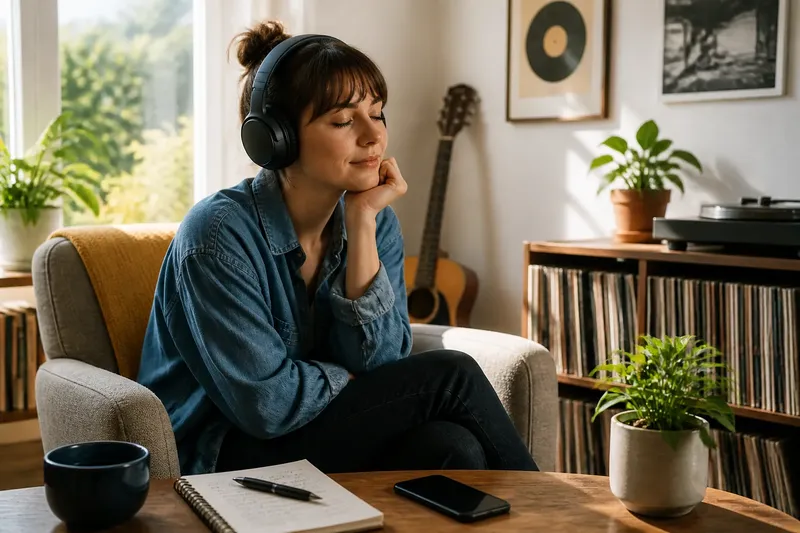
How do you hear a familiar song differently without turning an evening into homework? Try a three-listen ritual for a song you already know: follow one instrument, attend to the vocal phrasing, then listen for the spaces between sounds. Each pass has a single job, which is enough structure to sharpen attention and not enough to require a clipboard.
The point is not to uncover a secret meaning or prove that your favourite song has been misunderstood. It is to notice choices that familiarity has made easy to overlook: a bass note that changes under the same chord, a syllable held just past the beat, or a pause that gives the next sound room to matter.
One song, one evening
Say you have an unhurried evening and a song you know well: a track saved on your phone, perhaps, or one you can call up on a streaming service without searching for long. Imagine you choose a mid-tempo song with a lead vocal, a steady drum part and a keyboard figure. That is an invented situation, not a report of a listening test; the details simply make the routine concrete.
You settle somewhere comfortable, put your phone on Do Not Disturb and use headphones or speakers you already enjoy. Keep the volume at an easy level. Have a scrap of paper nearby if you like, but do not try to transcribe the song or identify every instrument. The aim is selective attention, not a full audit.
Before pressing play, choose a sound you can recognise. For this imagined song, choose the bass. If the instrument is hard to name, use a plain description instead: the low notes, the bright repeating figure, the sustained background chord. A useful target is one sound with a clear role, not a technical label you need to defend.
First pass: one instrument
Listen from beginning to end with attention on that single instrument. Try not to follow the words or decide whether the chorus is the best bit. Notice when your chosen sound enters, when it drops out, whether its pattern changes, and what it seems to answer or support.
In the invented song, the bass might begin with a simple pulse, become busier beneath the second verse, then settle back during the closing lines. Or it may remain steady while the other parts shift around it. Either way, the observation is useful: an instrument can contribute shape through movement or through restraint.
If your focus wanders, return to the chosen sound at the next obvious entrance. There is no need to restart. Write down one compact note afterwards, such as “bass gets busier in verse two” or “same low pulse throughout”. Keep it descriptive; “the bass makes the ending sad” is an interpretation, and you have two more listens before you need one.
Second pass: vocal phrasing
On the second play, follow the singer’s phrasing rather than the lyric’s meaning. Listen for where a line begins in relation to the beat, which words get extra length or emphasis, and where the singer takes a breath. The printed lyric, if you have one open, can be a distraction: your subject is how the words are delivered.
Suppose, in the imagined song, the singer begins one verse line slightly behind the drums, then lands the final word squarely on the beat. In another line, a breath may divide a phrase in a way that makes two short thoughts feel connected. Those are observable details. You need not decide whether they were deliberate; the useful point is what your ear can follow.
Notice the contrast between repeated lines, too. A singer may stretch a vowel the second time, clip a consonant, or leave less space before the next phrase. The words can be identical while the timing gives them a different weight. Make a note of one change, or of a repeated phrase that stays almost exactly the same.
Third pass: the spaces
For the last listen, pay attention to what happens when a sound stops, before another one begins, or behind a moment when the arrangement thins. These spaces are not empty in any simple sense. They let a note decay, a breath register, or an upcoming entrance become easier to hear.
In the invented track, perhaps the drums fall away for a brief moment before the final vocal line, leaving the singer exposed. Perhaps the keyboard continues through a gap in the voice, quietly joining two phrases. The expected result of this pass is a clearer sense of how the song manages room and attention—not a discovery that every pause carries a hidden message.
Listen for the shape of a sound as it ends. A cymbal may ring under the next phrase; a guitar note may be cut short; a small silence may arrive just before a downbeat. You can describe the event in ordinary language: “ringing cymbal carries on” or “brief gap before drums return”. Such notes are more useful than “the production is spacious”, unless you can say what made it feel that way.
Why three different focuses?
Each pass gives your attention a manageable task. Following one instrument makes changes in the arrangement easier to hear; following phrasing separates delivery from lyric content; attending to gaps makes entrances, decays and dropouts more noticeable. The routine does not claim to reveal everything in a song. It offers three distinct ways to listen without asking you to hold them all in mind at once.
The order also moves from a sound with a fairly clear identity to subtler relationships. A bass part can be easier to track than the exact length of a pause, while a familiar voice may draw attention naturally once you have already heard the arrangement around it. If the song is sparse, the order still works: choose a recurring instrument or sound, then the vocal, then the transitions and silences.
Do not force a result. A song may offer little change in the instrument you chose, or its vocal phrasing may be so consistent that the main observation is that consistency. That is still listening. The ritual is a way to direct attention, not a promise that each play will produce a revelation on schedule.
Questions worth asking?
Should I listen with headphones?
Use headphones if they are comfortable, but ordinary speakers are fine. Choose the playback setup you can hear clearly without turning the volume up to compensate for distractions.
What if I cannot identify an instrument?
Follow a sound by its character or place in the mix: low and pulsing, bright and repeating, or sustained behind the voice. Accurate naming is optional; keeping track of the same sound is the useful part.
Should I take notes while the song plays?
It is usually easier to listen first and jot down one observation afterwards. If a detail is likely to slip away, make a brief mark between phrases rather than writing a running commentary.
Can I use the ritual on a new song?
You can, though a familiar track makes it easier to notice details that were already present. With a new song, spend the first pass becoming comfortable with its broad shape, then use the three focuses on later plays.
Let the notes stop
After the third pass, look at your brief notes and choose the detail you would mention to a friend. In the invented situation, it might be that the bass grows busier while the singer gives a repeated line more room, and that a pause before the ending makes the return of the drums stand out. The result is not a verdict on the song, just a more specific account of what you heard.
Then stop, or play the track again without a task if you want to hear it as a whole. A three-listen ritual for a song you already know works best when it leaves the music more available to you, rather than turning your evening into an appointment with your own notes.