The Chorus Is a Return, Not Just a Repetition
Learn how melodic shape, harmony and lyrical emphasis make a chorus feel like a return, and hear which musical cue creates that sense of arrival.

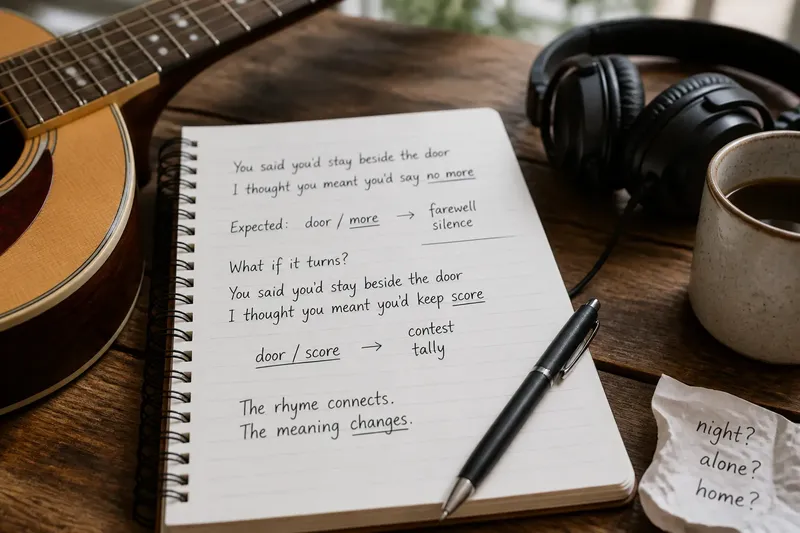
Why does a chorus feel like coming back, even when its words and melody have appeared before? In a song, a chorus can feel like a return because the route into it changes how familiar material lands. Listen for melodic shape, harmonic tension and the space given to a line, and repetition starts to sound like an arrival rather than a copied block.
Melodic return
A verse often keeps its melody close to the speaking range, moving in smaller gestures as it carries details forward. A chorus may rise, open into longer notes or place its main phrase higher in the singer’s range. The tune remains recognisable, but its physical scale changes.
That lift need not involve a dramatic leap. A chorus can begin on the same note as the verse and still feel broader if its phrases climb more often, settle later or leave more room between words. The verse tends to lean into what comes next; the chorus lets a central thought stand.
Some songs reverse this pattern. Their chorus descends or narrows, while the verse carries the wider range. In that case, the return may come from a repeated melodic contour or a stable landing note rather than a climb. The useful comparison is not “high equals chorus”, but whether the repeated section gives the ear a recognisable melodic home.
Harmonic return
Harmony supplies another route back. A verse may linger on chords that feel unresolved, move away from the tonal centre or delay a comfortable resting point. The chorus can then make that centre clearer, even if its chords are no brighter or more elaborate.
A familiar chord sequence can acquire new force when the preceding section stops short of resolution. A held chord, a bass note that points towards the next harmony or a brief pause can leave the listener expecting a landing. When the chorus arrives, the harmony answers that expectation. The same chord may feel different on its next appearance because the song has changed the context around it.
A chorus need not resolve everything. Some keep a question open, using a chord that leans into the next phrase or back towards the verse. The return may be recognition of a recurring harmonic pattern, not arrival at a final resting place. In a song built around sustained tension, a tidy resolution might be less satisfying than a familiar unresolved pull.
Lyrical emphasis
Lyrics help define what the chorus is for. A verse commonly supplies particular details, scenes or turns in thought; a chorus often gathers them into a concise claim, question or image. The words may repeat, but their function changes: the chorus gives the listener a phrase to carry away.
Emphasis can come from the arrangement as well as the lyric. A backing vocal may echo the last words, a drum pattern may become more insistent, or an instrument may leave space around the title phrase. If the singer repeats one line while the surrounding parts change, that line can sound newly exposed rather than merely familiar.
Not every chorus needs a larger arrangement. A sparse refrain can feel like a return because the singer delivers the same words with greater conviction, or because the accompaniment falls away at the point that matters. Loudness is one possible signpost, not the definition of arrival. A chorus can be quieter than its verse and still carry the song’s central emphasis.
Hearing a return?
Does a chorus need a higher melody?
No. A higher register is one way to make a return feel open, but repeated contour, longer notes or a settled landing can do the work instead. Listen for a change in melodic shape rather than treating pitch height as a rule.
Can the chords stay the same?
Yes. If the verse withholds a clear resting point, the same chords can sound more settled when they recur in the chorus. The approach to the progression matters as much as the progression itself.
What if the chorus repeats only one line?
A single line can act as a refrain when the arrangement or melody gives it a distinct place in the song. Its return may be marked by a pause, a change in vocal delivery or the way earlier lyric details point towards it.
How can I hear the difference?
Compare the last phrase before the chorus with its first phrase, then compare the chorus with the verse that follows. Notice where the melody settles, whether the harmony feels more or less open, and which words receive the most space.
Choosing a listening cue
These routes suit different kinds of songs. A melodic lift works when the chorus needs an immediate, singable release. Harmonic arrival suits verses that create drift or suspense. Lyrical emphasis helps when the central phrase matters more than a large change in pitch or accompaniment.
Say you are listening to an invented song whose verse circles unresolved chords and ends with the singer holding a low note. The chorus repeats the chord pattern, begins with a higher, longer-held melody and places its title phrase alone after a brief gap. The expected result is a clear return through melodic lift and lyrical space, even though the harmony stays the same. If you change the invented chorus so it keeps the low note but adds a chord that settles the tension, the arrival shifts towards harmony rather than range.
Start with the feature that changes most clearly at the boundary. If the singer leaps or sustains, follow the melody; if the bass or chords make the landing, follow the harmony. If neither moves much, attend to phrasing and words: a small pause can make a repeated line feel like the point of the song.
The boundary before
A chorus’s identity is often established just before it begins. A verse may thin out, a drum fill may point forward or the final lyric may leave a thought incomplete. These gestures create expectation; the chorus then answers, redirects or deliberately frustrates it.
This is why a chorus can feel like a return without repeating every musical detail. The listener recognises a destination through a combination of cues, while the arrangement keeps the journey from becoming mechanical. To hear what makes the chorus distinct, notice not only what comes back, but what the preceding section makes you ready to hear.