The Album Liner Note Before the Stream
Album liner notes gave listeners credits, context and clues to a record’s making, turning the sleeve into a companion for closer listening.
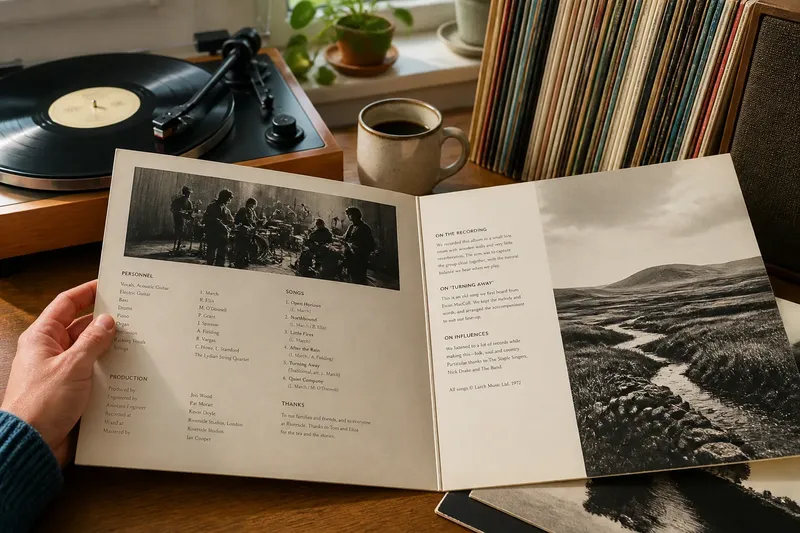
What could an album liner note tell you that the record itself could not? Before streaming separated music from many of its credits and commentaries, printed notes tucked names, context and small clues into the object you carried home. The album liner note was not merely packaging: it gave a listener reasons to hear a sound differently, and somewhere to look when curiosity outlasted the final track.
Its influence was modest and intimate. A name in small type could send you towards another record; a sentence about a session could make an unusual instrument sound newly deliberate. Here are the ways those printed pages shaped listening.
Credits Made Music Legible
A record sounded like a unified thing, but its credits showed the many hands behind it. Performers, songwriters, producers, engineers, arrangers and designers appeared in a compact roll call, sometimes alongside the studio or label. The list made clear that “the artist” was not always the only person responsible for what reached the speakers.
This mattered when a listener wanted to follow a particular contribution. A distinctive bass part might lead to a bassist’s name; a vocal arrangement might prompt a search for the arranger’s other work. The note did not explain every decision, but it supplied the proper nouns needed to ask better questions.
Credit was also a form of recognition. Names that could disappear into the general impression of a record were printed beside it, where an attentive owner could notice them. A sleeve could not fix every imbalance in who received attention, but it made some labour visible rather than leaving it to insider knowledge.
Context Changed the Ear
Notes could place a song beside a place, a tradition, a subject or a moment in the recording process. That context was not a substitute for hearing the music. It was a frame: the listener could return to a line, sound or arrangement with one more piece of information in mind.
Say you have a record whose percussion sounds unusually dry and close. The notes say the ensemble was recorded in a small room with little reverberation. You read that detail, then replay the track, listening for the drums’ short decay and the space around the other instruments. The note has not made the sound; it has given your attention somewhere useful to settle.
Good context left room for a listener’s own response. It could clarify a reference or explain a choice without dictating what the music must mean. The weaker kind of note supplied a verdict in place of a thought, as if the record had arrived with its interpretation already completed. A page of prose can be just as overbearing as someone talking through the quiet track.
Songwriting Acquired Company
Songwriting credits could reveal a piece’s life beyond the voice on the cover. A shared writing credit might open a route to another performer’s catalogue, while a traditional or adapted song credit could suggest that the version belonged to a longer chain of tellings. Even a sparse attribution could raise useful questions: who shaped the words, and what changed in this arrangement?
The answer was not always in the note, but the credit gave the curious listener a way to look. A name could be checked against another sleeve or a library catalogue; a songwriter’s work could be compared across different recordings. In this sense, liner notes were small maps of musical relationships, drawn in type too small for anyone who had misplaced their reading glasses.
That trail also complicated the tidy idea that a song simply belonged to the person singing it. Performance still mattered, but the print around the performance named other forms of authorship. Listeners could hear interpretation as an act of craft rather than as a transparent delivery of words and melody.
The Sleeve Invited Attention
Reading notes took place alongside handling the record: taking out the sleeve, finding the correct side and settling the disc on the turntable. The physical object set a pace in which looking and listening could overlap. One might read a credit during a track, then turn back to the music when a phrase caught the ear.
This was not automatically a better way to listen. Sleeves could be cramped, text could be faint, and a record could be put on while someone made tea or looked for the other side. Still, the notes offered a companion activity that did not require a second screen, a search box or a decision about which tab to open. The printed page stayed with the album, even when the listener’s attention wandered and returned.
That pairing gave the record an afterlife between plays. A photograph, dedication or paragraph could become familiar through repeated encounters, while the music itself kept changing with the listener’s attention. The album was both sound and a little archive, although the archive was sometimes held together by a folded edge and optimism.
Listening Gained Trails
Credits and references made discovery less dependent on chance. If a note named a backing vocalist, a session player or a source of inspiration, the listener could carry that name to a record shop, a public library or another sleeve. Each clue suggested a path outward from the album without telling anyone which path to take.
These trails could be personal and uneven. One listener might follow a producer’s credits; another might trace a lyric’s literary reference or compare versions of a song. The printed note offered no comprehensive guide to a genre, and it could not promise that the next record would be easy to find. Its usefulness lay in putting a handle on curiosity: a person, place or title that could be remembered.
The page also made discovery social. A friend could point to a name, pass over the sleeve or lend the record with a particular sentence circled in pencil. The context travelled with the object, ready to be noticed by someone who had not been present when it was first bought.
Limits Shaped the Form
Printed notes had space limits, production deadlines and the tastes of whoever commissioned them. Some albums came with generous essays; others offered a brief list of names and a copyright line. A sleeve could not be updated when a credit needed correction, and a claim printed confidently did not become sound merely by occupying a paragraph.
There was also a difference between useful context and publicity. Promotional language might describe a record in sweeping terms while saying little about its making or musical choices. Readers could treat such copy as one voice among several, then compare it with the credits and what they heard. The paper was part of the album’s presentation, not an impartial referee.
Those constraints help explain why the most helpful notes often did not try to say everything. A clear credit, a precise acknowledgement or a short explanation could do more than a grand account that smoothed away uncertainty. The listener remained responsible for listening; the page could only offer a few well-placed doors.
What Can Notes Tell You?
Why were liner notes printed?
They could provide credits, acknowledgements and context in a form that stayed with the physical album. Labels and artists also used them to present the record, so practical information and promotional language could sit side by side.
Did every album include an essay?
No. Some sleeves contained detailed commentary, while others limited themselves to names, titles and production information. The format varied with the release and its packaging; a listener might receive a rich account or little more than a useful credit.
How did notes help listeners discover other music?
They named people and relationships that were otherwise easy to miss, including songwriters, performers and producers. A listener could use those names to search a catalogue, inspect another sleeve or ask a record-shop worker for related work.
What can a listener do with album notes now?
Read them beside a physical record where available, or look for reliable scans and release credits when exploring an older album online. Treat commentary as context rather than a final interpretation, and follow any name or reference that genuinely sharpens your attention.
The album liner note before the stream made a record easier to explore without making it easier to explain away. Its most useful gift was not a complete account of how music worked, but a small set of names and clues that let a listener keep going after the needle lifted. If you come across a printed sleeve now, read it before the next play: a modest credit can be enough to change what you listen for.