Rhyme That Turns a Lyric
Rhyme that turns a lyric makes an expected word audible, then changes the thought with a surprising ending. Learn to hear the shift in a song.
Why can a line about leaving suddenly sound like a confession? Rhyme that turns a lyric lets you anticipate one ending, then gives you another. The first word sets a small expectation; the word that answers it can redirect the thought.
This is not merely a trick of vocabulary. Rhyme arrives at a point of emphasis, usually near the end of a line, where the listener has time to form a guess. If the lyric fulfils that guess, the sound can feel settled. If it alters the direction of the sentence, the ear notices the change as meaning, not just cleverness.
The ear makes a guess
Rhyme is a likeness of sound, typically at the ends of stressed syllables or words. In a song, metre, melody and repetition help establish when a rhyme is due. A listener need not identify the pattern consciously; familiar phrasing is quite good at making a prediction on its own.
Suppose a line ends with “light”. The next line’s rhythm and syntax may make “night” feel likely before it arrives. The lyric has created a narrow corridor of possible endings. “Light” and “night” complete the sound and may also suit the thought, so the result can feel smooth, even inevitable.
That smoothness has its uses. A predictable rhyme can make a refrain easy to remember, support a singable melody, or give a verse the shape of an argument. Expected rhymes are not dull; their effect simply differs from a rhyme that makes the listener revise the sentence.
When the ending swerves
An unexpected rhyme may preserve the sound pattern while changing the line’s emotional or logical destination. The listener hears the approach, prepares for one kind of word, and receives another. A turn can be comic, tender, bleak or sharply revealing, depending on what the new word makes visible.
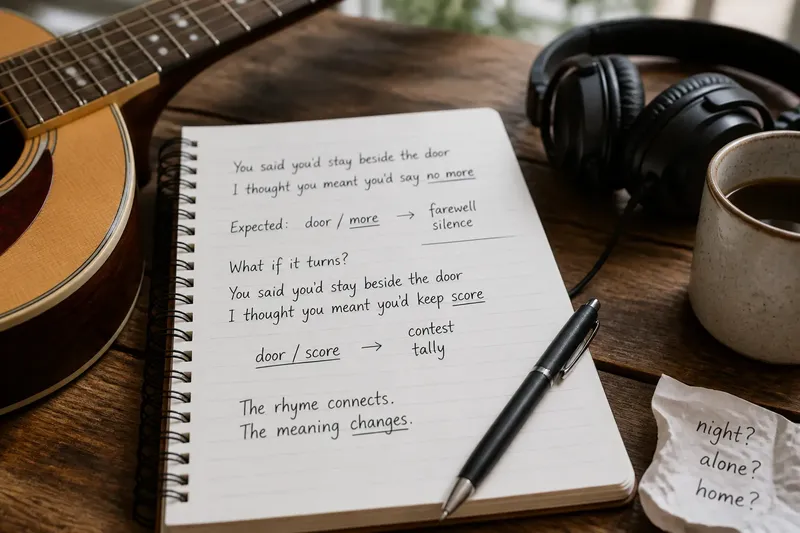
Imagine a songwriter has drafted a fictional couplet about an argument: “You said you’d stay beside the door / I thought you meant you’d say no more.” The second line fulfils a familiar sound and meaning. Now imagine the lyric instead ends its next line with “score”, making the speaker tally old grievances. The rhyme still connects to “door”, but the word shifts the scene from a farewell to a contest; the relationship begins to sound transactional.
The surprise need not be a rare or elaborate word. Often the turn comes from an ordinary word used in an unexpected grammatical or emotional role. “Home” can sound comforting after a promise, then become a place the singer refuses to return to. The rhyme makes that altered use land where the ear was already waiting.
Sound and sense
For a rhyme to redirect meaning, the words need to relate in more than a dictionary sense. Their sounds establish a link, while their meanings may agree, clash or expose an assumption. “Known” and “shown” can reinforce each other; “known” followed by “alone” can turn knowledge into isolation. The second pairing changes the emotional angle without requiring a new topic.
Rhyme can also make a listener reconsider the previous line. A surprising ending sometimes acts like a small correction: the first line seemed to describe one situation, but the second reveals a more pointed one. That backward effect is part of the pleasure. The line has not changed, yet it sounds different once the rhyme supplies its answer.
There is a useful distinction between a surprise in sound and a surprise in thought. A near rhyme, such as “shape” with “safe”, may catch the ear because the sounds are close but not identical. A semantic turn can happen with a perfect rhyme if the second word changes the stakes. The strongest moments may combine the two, though a lyric needs neither both nor elaborate wordplay to make its point.
Listening for the turn?
How can I hear the expected rhyme?
Notice where the line’s stress falls and what kind of word its grammar seems to require. Then pause mentally before the next line ends and see whether a likely rhyme comes to mind. The prediction need not be correct; even a vague expectation makes the arrival easier to feel.
What makes a rhyme feel surprising?
Surprise may come from an unusual sound match, a word with an unexpected meaning, or a shift in tone. Ask what the line appeared to say before its final word, then what that word makes it say now. If the answer changes the scene or the speaker’s attitude, the rhyme is doing more than decoration.
Does a near rhyme create the same turn?
It can, but it draws attention differently. A near rhyme leaves friction in the sound, which can suit uncertainty or unease; a full rhyme may make a semantic reversal feel more neatly delivered. The melody and performance can soften or sharpen either effect.
Can a predictable rhyme still matter?
Yes. Predictability can give a listener a foothold, particularly in a repeated line or a tightly patterned verse. It may also make a later departure more noticeable by establishing the sound the lyric is about to break.
Melody changes the landing
The written lyric is only part of the effect. A singer may stretch the final vowel, place the word on a high note, or leave a brief gap before it. Those choices can make a word feel like a revelation, a joke or an admission. A rhyme that looks modest on the page can become unmistakable in performance.
Melody can also conceal a rhyme’s arrival. If the tune carries across the line break, the listener may follow the musical phrase rather than the printed punctuation. A delayed ending can make the final word feel newly exposed. Conversely, a busy accompaniment may partly mask the sound, leaving the semantic turn to do more work.
When listening, separate the components briefly without treating them as rivals. First notice the word that closes the line; then consider the sound it answers; then listen to what the melody does with both. This can clarify whether the turn comes from the rhyme itself, the delivery or their combination.
Writing a useful turn
For a lyric writer, the simplest way to explore a turn is to draft the expected ending before rejecting it. Write down the obvious rhyme, then ask what a different word could reveal about the speaker, the scene or the image. The substitute should make the line more specific, not merely demonstrate that the writer owns a rhyming dictionary.
Read the pair aloud at the pace of the melody, or tap the intended pulse on a table. Check whether the surprising word fits the stress, whether the listener can understand it on first hearing, and whether it changes the thought. If the word only works after a footnote, it may be a fine word for another job.
It helps to distinguish a turn from a punchline. A punchline aims for a sudden effect; a lyrical turn can be quieter, altering the listener’s sense of a character or relationship without announcing itself. The ending may even become clearer on a later listen, when its sound no longer occupies all the attention.
Keep the sentence’s natural speech in view. A rhyme can pull a writer towards strained word order or a phrase nobody would say, and the tune may disguise that awkwardness only briefly. Sing the line plainly, then sing it in the intended melody. If the meaning survives both versions, the rhyme is more likely to belong to the lyric.
Let the second word matter
Rhyme that turns a lyric depends on a simple tension: the ear expects a sound, while the thought remains open to change. An expected ending can complete a pattern; an unexpected one can revise what the listener believed the line was doing. Hear both the word that arrives and the word you were quietly waiting for.
That gap is often where a lyric’s character appears. A singer may sound composed until a rhyme exposes resentment, or playful until the final word makes the joke cost something. The useful question is not only “What rhymes here?” but “What does this word make the earlier line mean?”